Archive for the ‘Columnists’ Category

Daniel Striani and Uefa’s Financial Fair Play regulations: the new Bosman?

Monday, May 13th, 2013

.

ANDREW NIXON is a sports lawyer, a partner in the sports group at Sheridans. He is a specialist in the regulatory framework of football and has advised clubs and individual players on regulatory disputes. In the first of a series of new columns for Sportingintelligence, Nixon explores whether a challenge to Uefa’s FFP regulations by a Belgian agent, Daniel Striani, could scupper the European body’s plans.


By Andrew Nixon

13 May 2013

In 1995 the case of Jean-Marc Bosman came before the European Court of Justice and changed the face of football in Europe. The case involved (amongst other issues) a challenge to the legality of the transfer system for football players.

The ECJ found in favour of Bosman and against his club, RFC Liege, the Belgium FA and UEFA, determining that transfer fees for out-of-contract players were illegal where a player was moving between one EU nation and another.

Almost 18 years later, a Belgian football agent, Daniel Striani, has lodged a complaint with the European Commission on the basis that UEFA’s Financial Fair Play Regulations are  anti-competitive and will negatively impact on his ability to generate income. It is a challenge that may yet have an impact as significant as that of Bosman.


Background to the Financial Fair Play Rules

The spending of football clubs, particularly those licensed by and under the jurisdiction of UEFA has long been an issue and a point of debate within the sport. In England, whilst commercial revenues have continued to rise (the Premier League sold the domestic broadcast rights alone for seasons 2013-2016 for £3.018bn), that has not necessarily reflected itself on the balance sheet, with many clubs having experienced falling operating profits and pre-tax losses.

Some clubs have been able to operate as normal, and indeed expand squads and wage bills, as losses were underwritten by wealthy investors and benefactors. Other clubs have operated at levels above their means, gambling player wages against receipt of broadcasting revenue, a strategy which has on more than one occasion led  to insolvency events involving high profile clubs.

FFP regs: challenged by Striani

In September 2009 the first steps were taken to positively address the spiralling debt within European football when UEFA’s Executive Committee approved the concept of financial fair play. The objectives were as follows:

  • to protect the long term viability of European club football;
  • to introduce more discipline and rationality into club finances;
  • to decrease pressure on salaries and transfer fees and limit inflationary effects;
  • to encourage clubs to compete within their means;
  • to encourage long-term investments in academies and youth infrastructure; and
  • to ensure clubs settle liabilities on a timely basis.

The overriding obligation on clubs licensed by UEFA is, over a period of time, to balance their books, or break even. Under the rules, clubs cannot repeatedly, as part of a multi-year assessment, spend more than their generated income, thereby enabling a longer term view to be formed.

The UEFA Executive Committee approved the creation of a Club Financial Control Body in June 2012 (replacing the Club Financial Control Panel) which oversees the application of the Financial Fair Play Regulations alongside the Club Licensing System and is competent to impose disciplinary measures.

Clubs have had their accounts monitored since summer 2011, with the break even assessment covering financial years ending 2012 and 2013, to be assessed during the 2013-14 season.

The principles behind FFP were also adopted domestically in England, initially by the Football League which has had to deal within a number of insolvency events and administrations. In the Championship, clubs have agreed to introduce a break even approach based on the UEFA FFP model, whilst in League 1 and League 2 clubs will implement the Salary Costs Management Protocol which (broadly) limits spending on total player wages to a proportion of each club’s turnover.

Just last month, the Premier League ratified its own financial fair play regulations which, amongst other elements, will mean that clubs with a total wage bill of more than £52m will only be allowed to increase the wage bill by £4m per season for the next 3 seasons (restrictions applying to broadcasting income only).


The Striani Challenge

The overall objectives of FFP are, on the face of it, in the interests of the game and its future as a self sustaining sport. Indeed, the licensee clubs themselves agreed to the implementation of the rules. Why therefore has Striani launched this challenge?

There are real issues of sporting regulation that will need to be addressed and analysed by the Commission. The key arguments that Striani will employ will be that the break even rule (article 57 of the UEFA Financial Fair Play Regulations):

- Will restrict outside investment in football clubs;

- Effectively preserves the dominance of clubs that do not operate losses by preventing clubs operating at losses in order to break through;

[NB: I wonder if the point here is that it preserves the dominance of clubs that have previously operated at a loss, eg, Chelsea and Man City), by preventing other clubs from doing the same?]

- Will dampen the transfer market and salary levels, with a knock on effect on Striani’s ability to generate revenue and income.


Is it a complaint with merit? 

The reality is that the competition rules of the EC Treaty were drafted with more orthodox industries in mind than sport and perhaps the key document when assessing the Commission’s attitude to sporting rules is its 2007 White Paper on Sport (PDF linked here), which addresses, amongst other matters within sport, governance and licensing.

Indeed, at paragraph 4.7 of the White Paper the Commission acknowledges the usefulness of robust licensing systems for clubs as a ‘tool for promoting good governance in sport’.

The Commission stated that these licensing systems generally aim to ensure that all clubs respect the same basic rules on financial management and transparency. However, such systems must be compatible with competition laws and the Internal Market provisions and must have at their heart a legitimate aim and objective.

There are a number of industry nuances which are recognised and will be applied when assessing compliance with Community law. For example, sport must involve uncertainty of outcome and there must therefore be a degree of competitive balance and equality within competitions, which of course sets it aside from other industries in which, unlike sport, there is no interest in competitors retaining economic stability.

However, despite these accepted nuances, the Commission will not reject the complaint simply because FFP purports to maintain competitive balance (indeed, one of Striani’s key arguments is that it does the exact opposite) as the ECJ has long since rejected the ’sporting exception’ argument on the basis that, as determined in an anti-doping case, – the Meca-Medina & Macjen v the Commission Case 519/04, ECR 2006 1-6991 - sporting rules do not fall outside the scope of EC Competition Law simply because they regulate sport.

The ECJ in Meca-Medina ruled unreservedly that although the doping ban was proportionate in the circumstances, and doping rules were a legitimate means of protecting sporting integrity, all sporting regulations which produced appreciable economic effects must be subject to review.

The objective of the anti-doping rules was to ensure fair competition, and a level playing field for all and were ‘inherent in the organisation and proper conduct of competitive sport’; however, will the Commission  (and if necessary the General Court and the ECJ) view FFP in the same light?

The Commission has produced a methodology as to how it will apply competition law to sport.

The first question to be considered is whether or not the body that adopted the rule is an undertaking, or an association of undertakings.

The second question will be whether or not the FFP regulations (specifically the break even rule) restricts competition, or indeed constitutes an abuse of a dominant position, and in answering this question the Commission will give consideration to the overall context of the rules, whether or not the rules are inherent in the pursuit of the body’s objectives and whether or not, in light of the overall objective, the rule is proportionate.

Thirdly and fourthly, the Commission will consider if the rule affects member state trade and if the rule fulfils the conditions of Article 101(3) EC.


What broad conclusions can be reached by applying this methodology to FFP?

Is UEFA an undertaking? An undertaking is described as an entity engaged in economic activity and there is no doubt that UEFA, and its member clubs, are undertakings within the meaning of 101 and 102 EC. Indeed, UEFA would be considered to be an association of undertakings.

Do the FFP rules restrict competition or constitute an abuse of a dominant position? Rules drawn up by a sports governing body will constitute a decision by an undertaking, or an association of undertakings. Therefore, on that basis, those rules may have the effect of distorting competition, even if the objectives are not such and there is merit in any argument that FFP has a distortion effect.

Do the FFP rules pursue a legitimate objective (the impact of which is proportionate to that objective)? The ruling in Meca-Medina discounts any reliance on the sporting exception argument. However, legitimate objectives will relate to organisation and proper conduct of competitive sport and, arguably, FFP complies with this requirement in that its objective is to safeguard the financial stability of the sport. However, the Commission will need to analyse whether or not FFP goes further than is reasonably necessary to secure the objective of financial stability.

Will FFP affect inter-Community trade? The answer to this question will almost certainly be yes and it is generally accepted that rules adopted by international sports governing bodies will affect trade when an economic activity is involved. In this case, FFP will inevitably have an impact on the transfer market and player trading between member states.

Is the restriction justified? It will be, but only if the beneficial effects of the rule outweigh its restrictive effects, and there is merit in any argument that it does not. The purpose of the break even rule is to ensure that clubs spend within certain limits, thereby ensuring they do not overstretch themselves financially.

From a competition perspective, this will inevitably dampen the player transfer market, which will have a knock-on effect on the ability of agents such as Striani to generate income. The rule will also prevent investment in clubs by third parties which will arguably preserve the dominance of certain clubs, as opposed to making the competition fairer and more balanced. That reduced investment will also have a direct impact on playing squads, both in terms of the level of player remuneration and the size of those playing squads.

The Commission responded positively to complaints raised with it in relation to the FIFA Player-Agent Regulations in the late 90s, eventually issuing a statement of objections in which it asserted that the FIFA Player-Agent Regulations contravened then article 81(1) of the Treaty by limiting access to the player-agent market. Notably, the Commission took the view that the objectives of the regulations could be achieved by less restrictive means, stating that:

“The Rules prevent or restrict natural or legal persons with the necessary vocational skills from having access to a job. The Commission recognises that there must be checks on access to the profession and that some rules are necessary in order to ensure the smooth operation and to prevent deterioration in the ethical values in sport. However, the rules must be in proportion to the objective pursued. There are clearly other rules which could ensure professionalism on the part of agents without being unduly restrictive.”

A key question will therefore be: are there other feasible rules which could ensure financial fair play in European football, which meet the objectives, but are less restrictive? Arguably, these less restrictive, objective meeting rules are already in force. It has always been the case that clubs are required to demonstrate, as part of the licensing criteria, that there are no overdue payables to other clubs, their employees, or to tax authorities.

Indeed, it will also inevitably be argued by Striani that there are other, better means of redressing competitive imbalance, such as a restructuring of the revenue sharing mechanism between clubs, with perhaps the adoption of a form of ‘tax’ on the higher spending clubs.


It is the writer’s view that employing a regulatory system of financial control is a justified means of ensuring that football clubs compete within their own commercial boundaries and the objective of FFP is therefore credible and justifiable.

However, it is entirely possible that the challenge will find its way to the CJEU and it will not necessarily be a comfortable ride for UEFA. Whether or not Striani can take his place alongside the likes of Bosman and Meca-Medina remains to be seen and will be watched with interest.


Andrew Nixon is a partner in the sports group at Sheridans. He is a specialist in the regulatory framework of football and has advised clubs and individual players on regulatory disputes. On Twitter, follow Andy Nixon and Sheridans


More sports law    /    Sportingintelligence home page

Follow SPORTINGINTELLIGENCE on Twitter

  • LinkedIn
  • Twitter
  • Yahoo Messenger
  • Share/Bookmark

Tell me why … my Wembley trips with Wrexham bode badly for Bundesliga’s finest

Tuesday, May 7th, 2013

*

Wembley, the national stadium and spiritual home of English football, will host the 2013 Champions League final later this month when Bayern Munich and Borussia Dortmund face each other. The German clubs come from a footballing nation where tickets are cheap, travel to matches is free or subsidised – and the average supporter isn’t just seen as another mug with a wallet to empty. Wrexham fan Ian Herbert has been lucky enough to see his own team play at Wembley twice this season, but asks: haven’t the authorities forgotten, again, the game is all about the fans?

.

By Ian Herbert

7 May 2013

One of the many great aspects of being a Wrexham fan is being able to say you’ve been to Wembley Stadium more times this season than either Dortmund or Bayern will manage.

The chance to place a Welsh flag in the Champions League Final at Wembley, where the German teams will meet 18 days from now, would certainly have been an historic treble.

But we’ve been there twice now, won the FA Trophy against Grimsby Town on penalties on 24 March, lost the more important Blue Square Conference play-off final 41 days later – that was on Sunday – and after the heartbreak that second appearance entailed everyone needs a good lie down.

Digested read: Wrexham, comfortably the better team throughout, concede on 85 minutes to a £25,000 player who they couldn’t afford to buy in January but who Newport County could. Too late to save themselves. Stuart James put it all much better in his report for the Guardian.

So, all in all, that’s quite enough for one year and my bank manager feels the same. All yours Dortmund and Bayern, he says – and on the basis of the past few months, it will be interesting to see what their fans of those two German sides make of the experience.

These are supporters, remember, who are accustomed to free local train travel to games within cities where Bundesliga fixtures are staged and cheap, subsidised train travel for longer journeys; who spend £10-15 for match tickets, £150 on season tickets; and who eat sausages for £3 before the game if my memory serves me from the Allianz Arena last season.

Some of those notions are not such an alien concept for supporters of Wrexham, a fairly representative club who sank from the Football League during a catastrophic period inflicted upon them because the Football League did not have any way to force proof-of-credentials from the men who took them over to such disastrous effect but who are gradually making their way back.

This is a club which is owned by its fans, now. One which charges £10 for junior season tickets.

But though it’s been extremely nice to go to Wembley twice, there were  aspects of these two big adventures which suggest that the Germans will be in for a surprise on 25 May. Small details, big prices. Things like:


ONE: Trying to buy a bag of chips for my nephews inside the stadium on Trophy Final day. There’s nowhere to buy just chips with nothing else. Has to be something with chips, burger with chips, pie with chips. Cost about £9.

TWO: Trying to buy a bag of chips for my nephews outside the stadium on play-off final day. The burger vans at the top of Wembley Way have melted away, making way for a building site. McDonalds built in the middle of a traffic island on Wembley Park Road, was the best option for cheap food at the home of football. Long queue, but chips in a bag, with nothing else, if that’s what you’d really like.

THREE: Trying to park the car for less than £30 – an issue of very pressing importance to Wigan Athletic and Manchester City fans who will be driving to Wembley for Saturday’s FA Cup final. They’ll be driving, you’ll recall, because they’ve been told by the Football Association that Saturday’s 5pm kick-off time will not be changed and that extra trains will not be laid to allow rail travel of any description back north after the game. Thoughts on that here.

On Sunday, we tried to find a solution – park at a Tube station a few stops north of Wembley Park. Which was all going very well until it emerged that London Underground have upped their ticket prices, “to encourage people to buy an Oystercard.” So, a three-stop, five-minute journey cost £8.70 return per person, on a Sunday. Nearly £20 for two of us. We might as well have parked at Wembley.

FOUR: Trying to get a decent read before the game. Of course, the match programme is obligatory on occasions like Sunday and for £5 you’re at least hoping for the kind of stuff you’d get on a match day at Wrexham’s Racecourse. Manager’s Andy Morrell’s programme notes were an uncanny, almost verbatim, report of precisely what he’d said on Radio Wales a week earlier, ten minutes after the semi-final win at Kidderminster. No player interviews. A profile of our legend Mickey Thomas. No quotes.

FIVE: Trying to get decent priced tickets. You might say, and I’d probably say, that £41 seats are not bad for Wembley. There was some scoffing about the two Welsh clubs in some realms of social media last week when neither side sold that many, but after the FA Trophy trip, many Wrexham fans couldn’t afford another one. The North Wales contingent was the larger and you wondered what the stadium might have looked and felt like if they’d halved the prices and just tried to fill the place. The attendance for Sunday’s final was 16,346. People will point to other finals – 42,669 for the Oxford United v York City Conference play-off three years ago – but even that’s only a half full stadium. It’s a chance to give the fans probably the only chance in their lifetime to support their team at this place.


From the supporter’s perspective, this experience is a very long way from disastrous. The stadium staff are excellent, patiently putting minds at rest when – for the umpteenth time, you sense – someone is worried about that incongruous tannoy announcement that all “large holdalls and bags” cannot be taken into the ground. (That does makes you wonder whether you’re going to be heading for a left luggage office at Euston before you’ve even started.)

It’s just hard to avoid the sensation that the demands of the stadium’s bank manager – the one who agreed to the mortgage which got the home of football place built in the first place – are the one which need to be met on these finals days.

And that the modest clubs must offer a helping hand like all the rest because Newport’s chairman and founder, Les Scadding, won the EuroMillions lottery after that expensive mortgage had been signed up to.

The bottle’s always half full in football’s lowers reaches though, because it needs to be. And it is with that philosophy that we can all view two pricey days out as very useful preparation for how life will be in those days, not so very long from now, when Wrexham have taken their place alongside Cardiff and Swansea in the Premier League.

Ian Herbert, who was shortlisted as Sports Journalist of the Year in the prestigious Press Awards, and highly commended in the SJA Sports News Reporter of 2012 category,  is The Independent’s Northern Football Correspondent (see archive of his work here). Follow Herbie on Twitter here.

.

More from IAN HERBERT

Follow SPORTINGINTELLIGENCE on Twitter

Sportingintelligence home page


  • LinkedIn
  • Twitter
  • Yahoo Messenger
  • Share/Bookmark

Tell me why … the English football authorities keep buck-passing the Blackburn farce

Tuesday, April 30th, 2013

*

English football has been a soap opera for years, an unending pantomime of drama, chaos, money, more money, haves and never-will-haves, millionaires, billionaires, plutocrats and conmen. The demise of Leeds was shocking, the demise of Portsmouth shameful. But one story now well into its third year that continues to be simply extraordinary is that of Blackburn Rovers since being sold in 2010. A court case this week has been the latest farcical episode among many. But when, asks Ian Herbert, are the football authorities actually going to do anything about it – or even realise they should?

.

By Ian Herbert

30 April 2013

The more ridiculous that the farce at Blackburn Rovers becomes, the more one wonders how English football’s governing bodies – the FA, the Football League and the Premier League – are able to keep passing the buck with no semblance of responsibility.

Do they not give a jot about the fans in all of this? (Hold that thought).

This is more pertinent than ever because of this week’s astonishing High Court proceedings which resulted in a judge kicking out Blackburn’s attempts to avoid paying Henning Berg the £2.25m they owed him.

It was Rovers’ lawyer’s job to make the best of the madcap evidence they presented him with and even Judge Mark Pelling praised Neil Berragan QC for his ingenuity in articulating that case “with skill and as well as it can be advanced.”

But the courtroom strategy of presenting Rovers managing director Derek Shaw – a rather grey businessman best known for his success in the shelving industry, as a maverick individual who ‘went rogue’ at Ewood Park, dispensing lucrative contracts and leaving the club’s Indian owners powerless to intervene – was, shall we say, ambitious.

It made for a couple of good days’ material, where there have been some moments of comedy gold to help this case along, like Judge Pelling’s image of Shaw with “a placard on his head”, saying “I’m in charge.”

We’ve also learned about the struggle of Mr Berragan to elicit a single shred of information from Blackburn’s owners, the Rao family, to help make the court case less zany. Not a single witness statement.

“Modern communications enables almost instant communications to take place between individuals anywhere in the world using video link, Skype, FaceTime, phones, email and fax,” the judge observed, drily, and you really could not quarrel with that.

Shaw (left) and Agnew, known to many fans as 'Shagnew'

So, without any help from India, we were left with the picture of Shaw and his old pal Paul Agnew, the erstwhile Rovers press officer who recruited Ewood’s new MD Shaw from their former stomping ground of Preston North End, meeting Berg at a Blackburn hotel for what the two Englishmen told the court was a “meet and greet.”

It was actually the meeting at which Berg and his agent Rune Hauge negotiated the contract which, when Berg was sacked, would entitle him to £2.25m for 57 days work comprising ten games and six Championship points.

Agnew (far right, with Shaw) tried to provide helpful testimony when the Indians decided they wanted to argue in court that this contract was invalid. But his statement “added nothing whatsoever” the court heard. Agnew didn’t actually sign it either, the court heard. Oh, and he submitted it after the court deadline. Not terribly useful for Mr Berragan.

Shaw tried to be as helpful, testifying in a statement that “I would have made it clear that the owners’ approval was necessary [to make that Berg contract binding]”.

But Shaw did not say  when  he would have “made it clear” or “even if he recalls saying what he maintains he would have said,” as the judge put it.

This and more reveals a club stripped of the most basic managerial infrastructure; lacking, it seems, the legal and HR facility to prevent that Berg contract being issued in the first place – and to prevent Mr Berragan being lumbered with such a shambolic case.

Is there a Rovers HR department? If the Indians’ case is to be believed, ‘global adviser’ Shebby Singh (Judge Pelling declined to use that title for Singh, on Friday) summoned  Shaw to a disciplinary hearing at the Ewood Park boardroom at 11am on 15 April without compiling a shred of evidence for such a confrontation. A disciplinary hearing organised “on the back of a fag packet” is how Berg’s barrister, Paul Gilroy QC, described this. A lack of managerial professionalism “so basic as to be beyond belief.”

Quite how Shaw feels about being characterised as a renegade who is out of control and running amok at Rovers is easy to imagine. The judge was actually concerned that Shaw might be making himself personally liable for some or all of the £2.5m owing to Berg, when the Lancastrian toed the line and said he did not have the authority to give the Norwegian that contract.

Shaw had been offered legal advice, the judge was assured, which didn’t entirely answer his concern. These are owners who do not take prisoners.

We now know all about Berg declining to attend a meeting which the club who had just sacked him asked him to attend, so that they could explain how they were struggling for the wherewithal to pay him his compensation. When Berg wouldn’t meet them he was told all his electronic devices would be seized, for an investigation into whether he had breached a confidentiality agreement after his sacking.

All of which needs to be related because it reveals the level of degeneration which needs to be brought to a halt.

I’ve argue elsewhere that it is not wilful incompetence on the part of the Blackburn owners – just incompetence.

But it was hard to disagree with the League Managers Association chief executive Richard Bevan yesterday when he said that it is now incumbent on the Football League to examine the details of the high court’s findings in the case.

Bevan believes that there is a commitment enshrined in the League’s constitution to ensure the proper and professional running of its clubs. That commitment is difficult to find.

The League’s regulations state that clubs must include in every contract an undertaking on the part of the employee not to bring the club of the league into disrepute. Yet nowhere does there seem to an undertaking for a club to meet that same test.

Clubs must ensure that any new officials comply with the obligations of the “Owners’ and directors” test. But once those officials and owners are cleared to take over, that’s the end of the story. They’re free to institute whatever kind of chaos they like.

The Football League did not want to talk to me on the record at the end of the court case which has dragged football through the mud. But the private view of some League officials is that the £2.25m hit Blackburn are taking for the woeful handling of this case is their punishment.

Football League insiders will also tell you privately that it’s not part of the League’s remit to stop clubs being run badly and if they do seek to take action then they, the League, run the risk of being dragged through the courts.

That’s the Football League fearing the prospect of courtroom action from a club which has just revealed derisory levels of competence in that environment.

What a dismal response. And what a contrast to the kind of proactive regime witnessed, for example, in the Bundesliga, which doesn’t seem so unfashionable any more and where, for example, it has long been the case that clubs must submit financial projections before each season to league accountants before they receive a licence to compete; and in an environment where close-up fan scrutiny comes as standard because fan co-ownership itself is standard as part of the ownership model.

Can we look anywhere else for the bodies governing the game to intervene?

It is now a matter of public record that the FA have an ongoing investigation into happenings at Rovers dating back more than two years.

The FA’s head of integrity David Newton is “looking at situations surrounding the takeover of Rovers in 2010 as well as control of the club since then and the involvement of agents and advisers.”

The exact nature of the FA’s investigations has not been declared, not in public, at least, although one might assume at the very least they involve some of the subjects this website has documented in detail since 2010. (Work backwards through this archive of related material and you’ll see what I mean).

So what do the FA say?

They have recently directed me to the Football League on the issue.

What do the League say? They don’t want to end up in court.

And the Premier League, under whose watch the club was first sold by the Jack Walker Trust to Venky’s amid the assorted dealings of various ‘finders’ and agents and agencies? The Premier League are long gone from this bombsite.

That is neither to damn or exonerate the organisation. In the past, notably as Portsmouth crashed and burned via shameful exploitation, it learned some valuable if painful lessons about the level of vetting required for an owner.

One lesson: a smudged photocopy of a passport (Ali Al Faraj) perhaps didn’t tell you quite everything you needed to know about a man’s suitability to own and run a club.

But learning is an ongoing process and there absolutely have to be lessons from the Blackburn debacle.

Surely all the governing bodies – for the fans’ sake – need to be more careful in checking not just that the owners are fit and proper, but that their advisors and consultants fit a similar brief. If any league can make a would-be owner prove their own credentials, surely it’s not such a great step to ask them to confirm who is advising them, professionally, or even running their club for them, in absentia?

The real tragedy of this situation is that Venky’s do not seem to be broke.

There are some fans, including the Rovers Trust, who are ready to take over if the club if it sinks into administration, and in a sense that collapse would be a happy event. The tragedy is that it won’t happen.

Rovers will just remain stuck in this state of farce and embarrassment, going round and round in circles while everyone passes the buck.

Ian Herbert, who was shortlisted as Sports Journalist of the Year in the prestigious Press Awards, and highly commended in the SJA Sports News Reporter of 2012 category,  is The Independent’s Northern Football Correspondent (see archive of his work here). Follow Herbie on Twitter here.

.

More from IAN HERBERT

Follow SPORTINGINTELLIGENCE on Twitter

Sportingintelligence home page


  • LinkedIn
  • Twitter
  • Yahoo Messenger
  • Share/Bookmark

Tell me why … genuine horror and pantomime plot are so blurred in Suarez bite case

Monday, April 22nd, 2013

.

Luis Suarez’s mouth-on-arm action when Liverpool faced Chelsea in the Premier League yesterday ensured a sea of headlines and that Suarez became the focal point of a debate about behaviour in football. Again. It goes without saying that his was an extraordinary act, one already punished by his club and certain to lead to an FA charge and deserved ban. But, asks Ian Herbert, shouldn’t we consider how much vicarious pleasure this episode has created, and why? Isn’t it all just another act in the Premier League pantomime, an act where we cannot even be sure whether a bite was really a bite?

.

By Ian Herbert

22 April 2013

It’s a very precarious business, suggesting that the reaction to the Luis Suarez incident might be lacking a little perspective. Any venture down that rocky road requires the caveat that what happened at Anfield yesterday was vile and abysmal. To have offended in this way once is a disgrace. To have done so twice is disturbing.

But let’s be honest. Where does the collective horror stop and where does the vicarious pleasure we can all take in this perfectly formed pantomime plot actually start?

A collection of pantomimes is what the Premier League season has come to resemble and the headlines in today’s papers reveal as much, where Suarez sinking his teeth into Branislav Ivanovic is concerned.

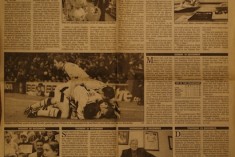
You’ll have found more than a few exclamation marks in there, on a morning which, as someone who rightly appreciated The Guardian’s representation of the story pointed out, was a reminder of the great value of print (right).

From “Same old Suarez always eating!” to “Gnash of the Day” in The Sun to The Guardian’s “Eats, Shoots, and Leaves?” and the i’s “Suarez’s bite leaves Liverpool with much to chew over!” the tone has reflected the tenor of much of the Twitter traffic in the hours since.

The #SuarezHungry and #PlayersOnTheSuarezMenu hashtags have taken hold and the jokes are still multiplying as I write.

“Suarez, still hungry? Uvanachick” states one advert (left) rapidly cooked up by Nando’s in Malaysia for their flame-grilled chickens. “You’ll never bite alone..” etc etc

Nice one Nando’s. The advert might not endear them to Liverpool fans any time soon but they can get away with it. And in a way that they would, quite naturally, not, if they were to have used some of the other atrocious moments on a field of play, from which footballers have emerged quite quickly to play for their clubs again.

The Roy Keane ‘tackle’ on Alf-Inge Haaland in 1997, for instance, or Keane’s stamp on Gareth Southgate, for that matter. No-one was suggesting that Keane should have played his last game for Manchester United after the first of those challenges but play the footage back again and tell me it was worse than what Suarez perpetrated at Anfield.

The question of whether bite is worse than a break to a player’s leg is a complicated one. Players will say ‘No.’ They’ll take what Ivanovic sustained ahead of Newcastle’s Massadio Haidara, under the boot of Callum McManaman at Wigan.

It’s partly a cultural thing, of course, tied up with that English football spirit which says this is a physical game and that to stamp is lower down the scale of the intolerable than the spiteful act of biting or spitting. It’s partly a media thing, too. Biting’s new, which means it’s news.

It’s a Suarez thing too. Any other player and it would be a serious inquest and news for one day.  A history of biting in sport would make for an interesting thesis, incidentally. The Guardian reported in 2002 on Aussie rules player Peter Filandia’s 10-game suspension for biting an opponent’s testicles during a game. Biting has happened and happens, among other places in the NBA and NHL, in English football (Defoe), and on the rugby field. The Northampton Saints and England hooker Dylan Hartley got an eight-week ban for it last year.

The search for some perspective will be helped by an understanding of what actually did happen, real-time, in that moment which was represented on our TV screens. If we are brutally honest and objective about the Suarez challenge, we have to say that we have no evidence that he actually did bite Ivanovic – only that he probably did.

What did the bite look like? Alan Smith said on the Sky Sports commentary: “He must have sunk his teeth in there I think. That’s what it looks like. Oh my word.”

And to be fair Smith could not have said more, because the only evidence we have is inconclusive footage and Ivanovic pointing to his arm. The contact, with the players in motion, lasts for something less than a second, and you can see that on the Sky footage via the Guardian below, around 43-44 secs.

Article continues below


Time for that caveat again. Even to make to bite a player is a deeply disturbing act which requires the Football Association to give this the ‘extraordinary incident’  label applied to Manchester City’s Ben Thatcher after his assault on Portsmouth’s Pedro Mendes. That will let them disregard the referee’s report and issue a long ban.

But can we truly extend that acknowledgement to say that this story deserves the incredible subplot which links Suarez with Mike Tyson, who we’re told has started following the player on Twitter as if they’re going to chew on a few malicious practices together?

Tyson chewed part of a man’s ear  off, for God’s sake. Ivanovic is not suffering in the way that Evander Holyfield did. Just another part of the pantomime plot, with Suarez playing the evil villain.

All of which means we are looking at a player who is being justifiably pilloried but who has not committed the worst act in the history of football.

Liverpool’s psychologist Dr Steve Peters discusses the mind as a constant state of conflict between the rational human brain and the irrational chimp in each of us. The chimp’s emotional response causes it to “think catastrophically… overreact to situations and fuel them with high and intense emotions,” he writes.

Suarez is not the devil incarnate. He is a flawed individual, and though Peters has his work cut out, he is not beyond redemption.

Ian Herbert, who was shortlisted as Sports Journalist of the Year in the prestigious Press Awards, and highly commended in the SJA Sports News Reporter of 2012 category,  is The Independent’s Northern Football Correspondent (see archive of his work here). Follow Herbie on Twitter here.

.

More from IAN HERBERT

Follow SPORTINGINTELLIGENCE on Twitter

Sportingintelligence home page


  • LinkedIn
  • Twitter
  • Yahoo Messenger
  • Share/Bookmark

Tell me why … the FA don’t look to Belgium for advice on fostering player-fan bonds

Monday, April 15th, 2013

*

Until quite recently, the Belgium international football team, and particularly its national governing body, had fallen out of favour with fans across the nation. The Belgian FA were perceived as a hindrance and a negative influence on the game; the team were not embraced. Ian Herbert explains how things have changed, rapidly. This is a story about marketing, but not as we know it …

.

By Ian Herbert

15 April 2013

The national cynicism and indifference about the Belgian team and the country’s Football Association has been like our own – perhaps worse – in recent years. That’s saying something in an era when it has been considered de rigueur to boo Ashley Cole and Gary Neville, to name just two, at Wembley and to launch insults at Rio Ferdinand, in absentia.

Neville came to hate playing at the old Wembley because of it.

When the Royal Belgian Football Association (KBVB) undertook a survey to find out how it was perceived, two years ago, it discovered that people had even less faith in it than they did the nation’s banks.

The KBVB were generally being slaughtered on Twitter – “a slagging” is how the Belgium FA’s business director Bob Madou describes it – and they knew that putting things right would be difficult, such were the negative connotations of the association and the cynicism of the nation’s media and the world of football.

What happened next was remarkable. The Association hired a marketing company, Boondoggle, and approached some of the squad’s more enlightened players – Manchester City and national captain Vincent Kompany, Tottenham’s Jan Vertonghen and Arsenal Thomas Vermaelen – to say that they badly wanted to do something about this reputation.

They wanted to introduce a new brand for the Belgian football team – who would become the Red Devils – but also to do something about the relationship between the players and supporters. The latter simply viewed the former as millionaires “who carried Luis Vuitton luggage and drove flash cars,” says Madou. There was no connection.

As Madou confided at the SoccerEx football convention in Manchester last week, the strategy was “not to concentrate on the opposition but on the relationship between the team and fans.”

The supporters were encouraged, though videos posted regularly by one or two of the players, to undertake challenges relating to the team’s matches. They were asked to paint the country red, for instance. And they were asked to fill the 46,000 capacity national stadium in Brussels with children’s pictures of the players. And to “collect” 500,000db of fan noise.

In return, the players would deliver something back which went beyond making an effort on the pitch.

They would be sprayed with red paint and they would select the pictures they most liked and show them on social media. In return for fans ‘collecting’ the noise, some of the players took part in a kick-about wearing inflatable sumo costumes.

Here it is (article continues below):


It’s great viewing, seeing Marouane Fellaini and Co launching into sumo mode, but it reveals a team spirit which draws the fans in. As one Belgian writer, Wim Van Walle, puts it: “The clips show a group of players who value each other’s capabilities and contributions. On top of that, they’re having fun. All of this has helped create a genuine love for the Red Devils, unlike anything since the 1980s.”

These are small gestures which, football being the cynical world it is, might provoke a sneer from some who read of it. But there is no doubt that they have inculcated the kind of excitement about Belgium’s games which tends only to exist in the heat of a summer international tournament.

A town called Geel (Belgian for ‘yellow’) renamed itself Rood (red).

Another of the paybacks for fans was to have 10,000 of their faces, from Facebook, etched onto the side of the red team bus, in miniscule. “I’m close to the wheel,” Boondoggle’s strategic director, Peter Verbiest, told SoccerEx.

The Belgian Red Devils own Facebook page is one of the fastest growing in popularity in the country.

Initially, there was no attempt to involve the newspapers. “We did not take the campaign to the journalists. There is no point trying to force things on them. It would have killed their enthusiasm at the beginning,” says Madou.

Instead, they let the relationship between players and supporters build – “the sumo was basically filmed in ten minutes after a training session” – and then the media wanted to get involved in what it considered to be ‘news.’

The paintings concept made impressive material: 46,000 flags with children’s paintings on, one on each seat. One of these drawings, of Eden Hazard (left), adorns the top of the Red Devils Facebook page.

There’s also been a new logo ‘red devil’ diable rouge logo – “it’s the ABC of marketing: if you are in deep shit, get a new brand!” says Verbiest – which is at the core of the new Belgian team’s Facebook page and a merchandising operation.

The Association wants to take the next step and put the logo on its team’s shirts, alongside the traditional logo which carries no real meaning. There are 220 official red devil fan clubs in the country, with 15,000 members.

Madou says there was no political intent behind the campaign but it is no exaggeration to say that the football team’s ‘adoption’ has had political consequences. The country is sometimes torn between its Dutch-speaking North and Francophone South, but the Belgians are supporting the national team as one. In October after beating Scotland, manager Marc Wilmots, who enjoys support from both communities called on his compatriots to “remain united”.

The Heysel stadium in Brussels sold out for the fifth successive time for the Scotland game in the World Cup qualifier last October – one of the Association’s prime targets when it began its attempts at re-engagement.

The emergence of an exciting, talented group of players has certainly helped, gradually convincing Belgians that the great days of the 1980s, when they were runners-up at Euro 1980 and reached the semi-finals of the 1986 World Cup, can be repeated. But the Association are convinced the support would survive the almost inconceivable notion of non-qualification for Brazil.

All of which provides a genuine reason why Kompany was so determined to return to play in this months’ qualifier against Macedonia – causing his club manager Roberto Mancini to criticise him, since he had not played competitive football since sustaining a calf injury in late January.

Madou was far too diplomatic to suggest that the Belgian nation were indignant about Mancini’s criticism of their captain. “I’m in the nice position that I don’t have to talk about players and their availability,” he said.

And yet it is clear that Kompany, more than any other player, has persuaded the younger, less deep-thinking members of the squad, like Eden Hazard, that participation in this campaign is something which actually do them a lot of good.

“I can honestly say that if I’m in conversation with Vincent it’s a completely different kind of conversation,” saus Madou. “I think he is not only intelligent but visionary in certain ways.”

SoccerEx neared its conclusion with Roy Hodgson ruminating on how clubs and players have presided over a “lessening” of the value of international football, by viewing international breaks as jollies to skip. The mood of gloom was unmistakable.

The Belgians will tell Hodgson that there can be another way.

Ian Herbert, who was shortlisted as Sports Journalist of the Year in the prestigious Press Awards, and highly commended in the SJA Sports News Reporter of 2012 category,  is The Independent’s Northern Football Correspondent (see archive of his work here). Follow Herbie on Twitter here.

.

More from IAN HERBERT

Follow SPORTINGINTELLIGENCE on Twitter

Sportingintelligence home page


  • LinkedIn
  • Twitter
  • Yahoo Messenger
  • Share/Bookmark

Tell me why … the real scandal of Di Canio’s appointment has been obscured by talk of Mussolini and fascism

Monday, April 8th, 2013

*

Sunderland’s replacement of the sacked Martin O’Neill with Paolo Di Canio dominated a nation’s sporting agenda for the whole of last week. But, Ian Herbert argues, the real scandal of the Italian’s appointment has nothing to do with far right politics or his past affection for war-time dictators.

.

By Ian Herbert

8 April 2013

The point has been made in a few places – best of all here - that our desire to shut down all shades of opinion which don’t conform to what is considered the norm is slightly fascist in itself, especially when we’ve not even examined the kind of fascism Paolo Di Canio was talking about when he described Benito Mussolini as “basically a very principled, ethical individual” and said: “I’m a fascist, not a racist.”

You’ll find that precise context here and it’s not all that it seemed when David Miliband made his stand and walked away from the club.

The real scandal is Ellis Short’s decision to hand the Premier League future of his club to a man who is so palpably destined to fail. It’s hard to speak so confidently about newly-appointed managers but the most cursory examination of the kind of leader Di Canio is reveals categorically that he will not succeed in the Stadium of Light hot seat.

How can we be so sure? Because of outrages like Di Canio’s treatment of the young Swindon goalkeeper Wes Foderingham, who was described by the Italian, his manager, as “one of the worst players I have ever seen in a football match” – after the Italian had hauled him off after a mere 20 minutes of his side’s match at Preston, last September.

I recall the Mail on Sunday’s Ian Ridley asking at the time what this outburst said about Di Canio’s ability to manage at the top level. “Can you, as a chairman of a club, rely on a guy like that? How is he going to behave under the scrutiny of the Premier League?” Ridley rightly asked – and only in the past 24 hours has the smokescreen of the 44-year-old’s Mussolini love cleared, to give us a picture of Di Canio the manager and his methods.

That compelling piece provided an exhaustive picture. There was Di Canio’s consignment of Swindon’s players to what they knew to be the ‘bomb squad’, when he’d lost patience with them.

The club’s Welsh youth team coach, Paul Bodin, is still on sick leave following the stress he suffered. All this and more is detailed and it is testimony to which David James added a powerful rejoinder, in his own piece about Di Canio yesterday.

James included the stories from within football of players being dragged in before dawn after a poor performance. James also placed the Mussolini talk in its proper context, as a relative insignificant factor in the bigger picture of whether this man can actually make Sunderland work and survive.

The appointment all contributed hugely to the Premier League pantomime, of course. When has a new managerial appointment made such an impact as Di Canio and his spangly jumper at Stamford Bridge yesterday?

But behind all the heat and noise lurks the cold, quiet, inconvenient truth that aggressive people like this are even less likely to succeed than the Mussolinis of this world. They are not destined to succeed at all.

Fascists have actually fared quite well in the sport – characters like Mussolini, for instance, who made Fifa an offer they couldn’t refuse to host the 1934 World Cup and then invited a friendly Swedish referee to officiate the semi- final, enabling the Italians to barge the Austrian goalkeeper. Il Duce then selected him for the final, where he did not notice a quite obvious Italian handball.

But managers, aggressive or otherwise, can’t appoint the referees, these days. A certain inhabitant of Old Trafford has been characterised as aggressive, of course, though I’ve always remembered a discussion I had with Gary Neville about Sir Alex Ferguson, around about the time that the ex-captain’s fine autobiography  Red was published.

“If you asked me how much of his 25 years there has been spent angry, I would probably say 0.001 per cent,” Neville told me. “The rest of the time he is a manager. You see him 99.9 per cent of the time on the training pitch. Every day he is talking to players about football, different things, how it went with internationals, normal conversations.

“He does have a streak, there is no doubt about that, and I think everyone is aware of that and it is something. But this idea that he’s always ready to let someone have it is wrong.”

Have you seen this film of Ferguson, interviewed by Fabien Barthez last year, incidentally? It tells you everything about Ferguson’s managerial perspective and it takes you a very long way from the hairdryer stereotype.

We are actually entering an environment when the study of how to get the best from football players is becoming more and more intelligent. I would say that the conversation I had a few weeks ago with Dr Steve Peters, the psychiatrist who helped coach Britain’s cyclists to Olympic gold and is now working with Liverpool FC, was one of the of the most revealing I’ve been granted throughout this football season.

Peters’ key strategy, common to the way he has worked in a number of elite sports environments now, is to eliminate fear, with its many paralysing effects out on the field or in the velodrome. Every available piece of evidence points to Di Canio introducing that commodity of fear, rather than seeking to remove it.

David James praised him for having “proved himself, with what he achieved at Swindon.”

Very generous praise, that. Swindon had a comparative fortune to spend and exited League Two via promotion having spent nearly £500,000 on agents’ fees – virtually the same as what the rest of that division’s 23 other clubs had done combined.

“Management by hand grenade” is how Swindon’s Nick Watkins has described Di Canio’s tenure. “Paolo would chuck a hand grenade and I would do the repair work at the end, like the Red Cross,” he said.

Didn’t Short or Sunderland check this out? Did they not seek references? Was there a rigorous appointment process?

‘No’ must surely be the answer on each count. It all adds up to calamity.

Ian Herbert, who was shortlisted as Sports Journalist of the Year in the prestigious Press Awards, and highly commended in the SJA Sports News Reporter of 2012 category,  is The Independent’s Northern Football Correspondent (see archive of his work here). Follow Herbie on Twitter here.

.

More from IAN HERBERT

Follow SPORTINGINTELLIGENCE on Twitter

Sportingintelligence home page


  • LinkedIn
  • Twitter
  • Yahoo Messenger
  • Share/Bookmark

Tell me why … all this Premier League money has made so many fans so miserable

Monday, April 1st, 2013

*

The Premier League has never been richer – and yet most of its clubs have never been more fretful. When the new three-year cycle of TV deals for 2013-16 begins this summer, some £5.5bn of TV cash alone will pour into England’s top division. That makes it more important than ever for clubs to stay there, and more and more desperate for those who fear missing out. Instead of relishing the riches, the beautiful game has become a nine-month exercise in stress for many fans, and Ian Herbert for one argues there is greater contentment elsewhere.

.

By Ian Herbert

1 April 2013

I got to thinking about this when I came across one my favourite old photographs (below).

It’s me (far left), my twin brother Pete (grinning, right) and dad in the crowd at Upton Park in January 1992 to see Wrexham’s FA Cup fourth-round tie. West Ham were four leagues above us and the game would end 2-2 but we didn’t know that would be the outcome when the photograph froze the moment in time before kick-off.

The grins were quite possibly about the Monopoly notes floating around on the east London breeze in a mood of fraternity for Mickey Thomas, about whom there had been rumours of involvement with funny money – over which he’d later be arrested.

Most of all the smiles were about knowing that winning was possible and that anything could happen that afternoon, a few weeks after we’d put Arsenal out of the competition, with Thomas prominently involved.

On a week-to-week basis, that much is true in the Premier League; winning on any given day remains possible. Hence Southampton fans can believe in anything after beating Manchester City, Liverpool and Chelsea in recent weeks.

But the broader perspective of playing in the Premier League for a season doesn’t make such a happy story. Could anything happen for teams in this division? Not really. The best that might occur for most clubs is survival and the worst outcome – spending nine months stalked by relegation – has befallen more clubs than ever in the 2012-13 season.

It has been the campaign which the term ‘bottom 11’ has come into play; all of them fighting for the right to stay around for another season of fighting to stay around. The impending new TV deal raises the stakes and only compounds the kind of madness which is now unravelling at Sunderland.

The fans there don’t seem to be protesting much about the inestimably poor decision to dismiss Martin O’Neill in favour of Paolo di Canio, whom the former Swindon chairman Jeremy Wray says will be box office, which isn’t the most encouraging endorsement of a man who has left some managerial carnage in his wake. Few teams have less to grin about than Sunderland.

I’ve been grateful over a number of months for the great work the financial writer Ed Thompson has done on the club, which enabled us to report on the day that O’Neill was presented as manager that the Northern Irishman would need to stem the wage bill as the club were careering towards failing Uefa’s Financial Fair Play test and being denied a license to lay in Europe, if they were actually to achieve such a goal.

A full 16 months on and their picture hasn’t changed. Sunderland quietly slipped out their financial results the Friday before last – a practice now depressingly common among clubs with bad news to bury, as Ed writes here – and the latest £26m loss, taking their own losses to £44m over two years, means that their proprietor, Ellis Short, will need to inject around £30m of equity into the club if they want to meet the financial threshold which allows them to apply for a UEFA license.

As Ed says, the Premier League don’t disclose which clubs don’t apply for a license so it is possible, so if Short doesn’t fancy laying out that money, the club may simply not apply. That would mean the fans turning up to the League Cup and FA Cup games, unaware that the club cannot compete in UEFA competitions even if they are successful.

We were not totally delusional about Wrexham winning the FA Cup that year at Upton Park but at least there were grounds to dream about all outcomes – justified, when the club made the quarter- finals a few years later.

Of course, there’ll be no protests about O’Neill’s sacking, as fans possess that eternal belief that the new man just might be a better man than the last one and that always limits the sense of outrage.

Reading fans have tolerated Brian McDermott’s departure, and the soaring achievements of Southampton’s Nigel Adkins were not enough to provoke much outrage when he went. Harry Redknapp was hailed as a saviour but where are QPR now?

The new Premier League TV deal has simply made the desperate a lot more desperate, in the Premier League and in Championship.

No fewer than 55 of the 92 Premier League and Football League managers have been in work for less than a year.

The concept of changing horse two or three times a year is no longer unheard of. Those in the managerial profession feel like a bunch of freelance sub-contractors now, as LMA chief executive Richard Bevan said a few weeks ago.

It all seems like a fairly desperate place and though Wrexham attest to the fact that there are no guarantees of greater contentment outside of the top flight – they plummeted into the Conference five years ago, shortly after moving out of administration – it seems like an infinitely finer ride.

One of mates my called the FA Trophy final “that FA thing” last week and few will be able to name the finalists but that day out to Wembley, beating Grimsby Town and seeing the trophy cup lifted was sweet. The ticket’s been framed and is on the wall. Not a lot of Premier League fans can say that.

Ian Herbert, who was shortlisted as Sports Journalist of the Year in the prestigious Press Awards, and highly commended in the SJA Sports News Reporter of 2012 category,  is The Independent’s Northern Football Correspondent (see archive of his work here). Follow Herbie on Twitter here.

.

More from IAN HERBERT

Follow SPORTINGINTELLIGENCE on Twitter

Sportingintelligence home page


  • LinkedIn
  • Twitter
  • Yahoo Messenger
  • Share/Bookmark

Tell me why … society demands black and white when real life is 50 shades of grey

Monday, March 18th, 2013

*

IT would be nice to think that definitive answers exist to every question, that truth is absolute and there is only one way to see things – because then we could always be clear and what is right, wrong, true, false. But life isn’t like that, not any walk of life from medicine to the law to sports journalism. As one newspaper takes the rare stance of a prominent mea culpa for getting a story wrong, Ian Herbert explains that the whole story is most often found in the shades of grey

.

By Ian Herbert

18 March 2013

I’ve been in journalism for 24 years and I admit that I sometimes still deliver information with less than 100 per cent certainty – and sometimes get it wrong.

I said that Nicolas Gaitan of Benfica was probably coming to Manchester United; that Kaka was almost certainly coming to Manchester City; and that a Chinese businessman called Kenny Huang had the financial muscle to buy Liverpool. None of it true.

None of those days were my best at the office. I’d like to say that the biggest contributor to these errors was the shifting tide of events – by that I mean the information was right when I wrote it, but things don’t always turn out how they seem – which would ease me of the hook. But that wouldn’t be true. It was the contacts who didn’t turn out to be quite what they seemed to be. I’m not alone in that.

Don’t get me wrong – this is not serial offending. I have written 5,000 newspaper articles and you cannot tell me many of them were wrong at all.

But everyone makes mistakes in good faith sometimes. And this whole area has now become a topical thing to write about in the hours since The Times acknowledged it was duped into running a story about the state of Qatar proposing a lucrative new summer football tournament.

It admits that its London office had not been stringent enough before rushing to publish a story by Oliver Kay, the paper’s chief football correspondent, whose combination of contacts, knowledge, magisterial writing and prodigious output really make you wonder why you bother getting out of bed some mornings.

But it wasn’t this case that sent me off in the direction of writing about this subject. That happened when I found myself bestowed with the privilege of being asked to speak about my job, last week, at the burgeoning literary festival which has become an important event in the calendar of my home town, Oswestry.

I wasn’t sure how the evening would go. This year’s programme, including the writers Rachel Joyce and Michael Morpurgo, reflected the growing reputation of The Oswestry Festival of the Word, now in its fourth year.

I wasn’t much inclined to mention on social media that I was doing a turn, given that football writers rarely feel the love and I didn’t want to bring any hate to the place I call home. But the venue – the town’s very fine library – was full, the discussion was full and frank and the most excellent part took us, unscripted, into the territory of degrees of certainty and uncertainty in football journalism.

The context was easy to communicate. How the days of footballers talking to players – “Treat the press as you would a policeman,” as Matt Busby once put it – are now gone, and that you’re viewing the game as if from the bottom of an ocean and drawing information from around the edges as best you can; contacts twice or three times removed, agents with an agenda, chancers masquerading as something else, and plain chancers.

We had lingered for a time on this topic, knocking it this way and that, with the general message being that readers will take the shades of grey, thanks very much.

So how many in the audience would want a story whose writer was 50 per cent sure of it? About 50 per cent, it seemed, from the show of hands, which didn’t include the man shaking his head in the back row.

“I’m a scientist,” he said. “I can’t work on guesswork. I need certainties.” To which, a reply from across the room. “That would just be boring…”

And so it went on; a bit of spikiness but deference also, given and taken in equal measure. Later, I met the excellent scientist and we’d reached an accommodation on 50 shades of grey, so to speak, before we parted. 

Which leads me to ask you: what profession actually does operate on 100 per cent certainty? A lawyer can no more tell a client that 12 good men and true will acquit him than a doctor can entirely predict the future for a patient. We’re all operating in slippery places.

The next morning, I met reporters from North Wales Newspapers and the local Oswestry and Border Counties Advertiser, the title I first worked on in the summers of the mid 1980s, whose editor Susan Perry is to grow the sales of three weeklies simultaneously – while presently seeing off the threat of a competitor who, as far I can see, have got away with pinching the name of one of them by launching a free Oswestry and Border Counties Chronicle.

Talking to her reporters David Lawson, Richard Jones, Jonny Drury, Dominic Robertson and Emily Davies offered a new window onto a fine and indefatigable industry in the post-Leveson era.

The ripples effects of telephone hacking are palpable here, where attempted vox pops elicit more suspicion and the time-honoured practice of working through the phone book can bring questions about hacking.

But these reporters were able to deliver extraordinary papers when the town encountered two cases of filicide barely a year apart because of the reporters’ relationships with that list of people they need to call in a crisis. It is a list to fret over, in constant need of renewal. And the renewal of this list is what Premier League football reporters do – more, I would say, than any other branch of the profession.

Barney Ronay wrote recently that everyone is a football writer now, such is the supporting cast of thousands who tweet, blog, tactically analyse and over populate press rooms. But let’s make the distinction between the ‘writer’ and the ‘reporter’ because the latter category – the ones who ring and build and probe and deliver details previously unpublished – are a very different specimen from those who just expound – and who generally make a lot more noise on Twitter.

“Where are the quotes to prove it? Lazy,” someone tweeted me the other week, as if any of the best information is actually going to come with the source’s name in lights. That was more of the ground we covered last Thursday.

It’s what degree of certainty to publish on that remains the very big question. You can palpably feel how those percentages rose, higher and higher, for The Times, when you read back today’s explanation. And when the fullest version of how Rob Beal played a substantial role in duping The Times is finally told, my guess is the average reader too will realise this wasn’t some slapdash caper by the paper.

There is already some hand-wringing in some parts of the industry, today, about reputational damage, much of it delivered with a heavy dose of schadenfreude.

Should the paper have published a graphic? Should it have shut up shop when immediate scepticism kicked in? Probably not, probably so.

But there but for the grace of God. It’s the world we’re occupying.

Shades of truth and lies and no simple calculus to work through it.

. .

Ian Herbert, who was shortlisted as Sports Journalist of the Year in the prestigious Press Awards, and is shortlisted as the SJA Sports News Reporter of 2012,  is The Independent’s Northern Football Correspondent (see archive of his work here). Follow Herbie on Twitter here.

.

More from IAN HERBERT

Follow SPORTINGINTELLIGENCE on Twitter

Sportingintelligence home page


  • LinkedIn
  • Twitter
  • Yahoo Messenger
  • Share/Bookmark

Indian Wells: the gift that keeps on giving

Thursday, March 7th, 2013


*

ALEXANDRA WILLIS is a multimedia tennis journalist who flits between WimbledonSportingIntelligence, the TennisSpace and a few other outlets, while tweeting copiously and trying to improve her (terrible) backhand in her spare time. 


“If I were to go to a tennis tournament, it would be Indian Wells. No question.”

That statement was not uttered by an employee of Desert Champions LLC, the company which owns and runs the 10-day hard court tournament at the Indian Wells Tennis Garden. It wasn’t anyone employed by Larry Ellison, one of the most popular benefactors in tennis, whose seemingly limitless chequebook has turned Indian Wells from the brink of a yard sale to its current position of strength.

It wasn’t a tennis player, or member of the press, or anyone else associated with the game. Instead, it was an unsuspecting nameless member of the public, whom I happened to hear in the boarding queue at San Francisco airport. How and why Indian Wells came up in his conversation with another unsuspecting nameless member of the public, I don’t know. But the sentiment rings true.

I had my first pootle about the Indian Wells Tennis Garden two years ago, and ever since then, it is a tournament that I would put on my go-to list every year. I feel almost as strongly about it as I do about ice cream.

But there is a very real reason that players, press and public wax more than lyrical about tennis in the desert. Because the BNP Paribas Open is a tournament that is constantly nipping and tucking at itself to be better. With one of the most powerful men in the world at its helm, that may not be a surprise. But you could see the temptation for Tournament Director Steve Simon and his crew to rest on their palm-shaped laurels. And yet they do exactly the opposite.

The Indian Wells Tennis Garden

True, Indian Wells benefits from one of the most stunning backdrops in the tennis world, the sandy-coloured mountains meeting the sky head on in a blur of bumps and crevices. Rows upon rows of green hard courts, decorated by palm trees, somehow look picturesque rather than like an overflow of concrete. And then there’s all the grass. In a desert.

But a nice view does not win approval on its own. The Foro Italico in Rome is a setting steeped in history. And yet the poor Romans bore the brunt of a lot grumps last year.

The reason Indian Wells has become a tennis fan’s nirvana is in the attention to detail that has turned the dilapidated into the dignified. What has become one of the largest tournament sites in tennis is an open and inviting space that benefits from 350 days of sunshine and a constant 70-odd degrees. But beautiful weather can soon become a burden if there is no shade. Sunburnt people are not happy people. Cue the building of a 19,140 square foot shaded structure in the public area of the grounds last year, a principle that has been applied to the player and media dining area this year. Another is planned for next year.

Two years ago, seating was installed around the practice courts, recognition of the fact that fans can learn just as much from players having their daily or twice-daily hit about as they do from watching them compete, and allowing them to do it in an orderly, controlled fashion, rather than a pressed-up-against-a-fence type scrum. And, crucially, information towers around the grounds were put in to tell the fans who was practising when.

Another example is the provision of additional parking in 2013. No matter how much someone is looking forward to their grand day out, if they’ve been waiting in a parking queue for an hour, even the sight of Rafael Nadal playing football might not enthuse them immediately. Thus, there are plans to add to the already extensive 55 acres of outdoor parking with spots for 2,000 more cars.

It is with learnings like these in mind that Indian Wells, with the support of the local council, has announced an onsite expansion plan worthy of the four Grand Slams. Which other tennis tournament has the luxury of being so secure in its plans for the future? Most spend the majority of their efforts recruiting players and selling tickets.

The biggest and boldest enhancement will be the construction of a brand new permanent 8,000-seat second court to join the 16,100-strong Stadium 1, the second-largest tennis stadium in the world behind the goliath that is Flushing Meadows’ Arthur Ashe. Then there are the two new restaurants, a new marquee site entrance complete with new box office, four additional practice courts, and

“We are extremely excited about our expansion, and thrilled that the City of Indian Wells has approved our plans,” said tournament CEO Moore. “Larry Ellison’s vision for this tournament has been nothing short of incredible, and the innovations and enhancements he has put forth have benefitted fans and players alike. These tournament-specific changes will continue to put this facility on par with the best in the world, deliver an unparalleled experience for fans and ultimately make the BNP Paribas Open better than ever before.”

There are the headline-grabbers, too. Two years ago, the installation of Hawk-Eye on all eight match courts, the only tennis tournament in the world to offer the player challenge technology on every court. This year, the record $11million prize money pool. Next year?

Work is also being done to raise Indian Wells’s international profile. Stuck in a tough spot in the American sporting calendar, sandwiched in the middle of March Madness (that’s college basketball to the non-American), getting a proper profile on the American TV networks has been tricky. So, instead, 2013 sees the introduction of BNP Paribas Open Radio, a live radio presentation from all around the grounds staffed by the voices who bring Wimbledon to life on BBC Radio 5 Live, available to tennis fans around the world online.

Then there’s ‘Live at the BNP Paribas Open,’ which bears an uncanny resemblance to the All England Club’s Live @ Wimbledon, and not just in the name. A live online preview show from inside the tournament grounds, fronted by Tracy Austin and other assorted tennis stars, it aims to bring Indian Wells to life in a different way.

And, from 2014, with an expanded and relocated TV production compound, ESPN could be wooed back to the garden full-time.

And this is without even mentioning what the tournament does for the players. The grassy area for football, stretching, and whatnot one of those things I’ve never seen at a tournament anywhere else.

“Anyone who knows me understands how much passion I have for the sport of tennis,” Larry Ellison has said. “My goal was to build upon the legacy that this event created before I owned it, and push the boundaries about what is possible in the future. I am certain we will continue to cement ourselves as one of the best sporting events in the world.”

With what Ellison has achieved in just three years, his statement seems unfailingly true.

.

Visit the Sporting Intelligence home page for the latest news and exclusives

More on tennis / More from Willis

Follow SPORTINGINTELLIGENCE on Twitter

  • LinkedIn
  • Twitter
  • Yahoo Messenger
  • Share/Bookmark

Tell me why … the abuse I get from Manchester City fans surpasses all other

Monday, March 4th, 2013

*

Social networking has myriad upsides, few would disagree. And no journalist working on a national platform can expect that their work will pass without criticism. It’s never been quicker or easier for readers can make summary judgement, for good and ill – and many routinely hurl abuse. Getting that kind of feedback is par for the course for most writers. That’s free speech. But Ian Herbert wonders what on earth he must have done to enrage fans of Manchester City, given acres of positive coverage over numerous years, when the smallest thing can set some of them off into paroxyms of rage and bile. Is it just his name? Or his beard?

.

By Ian Herbert

4 March 2013

Tell me why the abuse I get from Manchester City fans surpasses all other.

“Because you’ve got a name and reputation for dissing our club,” is no doubt one response.

“And you’ve got a beard for it.”

Yes, they’ve certainly been cropping up on Twitter in the past week.

One soul took the time and trouble to share the view that I embody nominative determinism. Herbert by name, herbert by nature. Nice one.

It’s strange, though – the things that can invite rebuke in these days of Twitter which, to quote a mate of mine, would a bit like having all your favourite people in one room if you could only shut the leery gatecrashers who just want to have a go.

One of my heinous recent offences was tweeting a link to a match report on City’s 2-0 win over Chelsea about a week ago and, often lacking originality, I copied out the headline that the folk back in the office at The Independent has used on the paper’s website.

It mentioned that Toure and Tevez had settled ‘El Cashico’.

It wasn’t exactly meltdown – I’ve not got that kind of following – but the red light on the phone did look like it might melt the thing as the tweets came in.

It’s naivity, I’m sure you’ll tell me, but I just didn’t get the Twitter semantics. The case against (me) is that El Cashito is an insult and a putdown, which fans believe define City as the height of chav. “We’ve been waiting all day to see who’d use it,” someone said. Honestly? You did that?

Then I wrote about City’s plans for world domination. This is a club who’ve always been ambitious and resolute about breaking new ground, ever since Sheikh Mansour bin Zayed al Nahyan took over and appointed individuals like Khaldoon al Mubarak and Simon Pearce – people who run global businesses and invest petrodollars on a scale way beyond the purlieu of Premier League football – to accomplish the task.

There were serious details in there about how the club will seek partnerships in at least three continents, are overhauling merchandise and re-ordering the business. I’d been poking around at it for three weeks. Just ask the City people I’ve been mithering.

That story got some red light responses too, all right – but not a single one of them about City’s pursuit of globalization.

Every last reaction related to me reporting what I have been privately told about the club – that despite a feasibility study they’ve not been ready to expand the size of the Etihad stadium until they know they can fill the thing. City’s gates a very good, in the league at least, but they don’t sell out every game in every competition.

The club is still growing but there’s not an Arsenal-type fan base just yet. Which intensifies the need for global revenue.

“Why lie?” I was asked, as if I’d invented the fact that seats have been available for some City games this season. “Why didn’t you research?”

I was even getting links three days later to stories of City’s forthcoming game with Newcastle being a sell-out.

The process of establishing facts doesn’t always entail being able to tell who told you them. It’s not every executive who wants his name in lights and speech marks. City’s official capacity from Premier League games is 47,805. The biggest attendance this season is 47,386.

They sometimes manage to re-sell the away quota of tickets which are returned to them but not always. The cup attendances are less than the League: 28,015 against Aston Villa in League Cup, even with discounted pricing. Source: Manchester City’s match programmes. More details here.

City are trying to expand in innovative ways. Social media means we can discuss that, if anyone wants to. Yet all anyone wants to talk about is home attendances. Tell me why?

Because of all that public criticism City got from certain members of the commentariat when they became wealthy overnight?

Because Manchester United happen to be the best example of the way to go and tend to be a point of comparison?

Because Twitter is an overrated pit of abuse? Any one of the above.

I’ve been writing about City for five years. The Sheikh arrived not long after I started writing about football. The club are also one of the most open and willing to engage, which has nurtured a better understanding of what they’re about than any other club, for many of us.

They’ve had managers who’ll talk and who don’t resort to ridicule ands put-down, like Sir Alex Ferguson does, when an individual’s questions are uncomfortable ones.

So I’ve written about their Etihad Campus, their excellent former technical director Mike Rigg – who was installed by Mark Hughes. I’ve always felt that the public ridicule heaped upon former chief executive Garry Cook disguised his brilliance. And I think that Roberto Mancini is too exacting of his players and too willing to censure them publicly to take the club on.

I’m not a Manchester United fan. I was brought up in North Wales and support Wrexham, who do not fill their stadium.

I do have a ridiculous surname . That’s it: off to trim the beard.

.

Ian Herbert, who has been shortlisted as Sports Journalist of the Year in the prestigious Press Awards, notably for his coverage of the Hillsborough Independent Panel,  is The Independent’s Northern Football Correspondent (see archive of his work here). Follow Herbie on Twitter here.

.

More from IAN HERBERT

Follow SPORTINGINTELLIGENCE on Twitter

Sportingintelligence home page


  • LinkedIn
  • Twitter
  • Yahoo Messenger
  • Share/Bookmark